Marketing for Architects in the Age of Insularity
The 2026 Edelman Trust Barometer surveyed 33,938 people across 28 countries. Its headline is blunt: trust has retreated inward, toward the small, the local and the familiar. For architecture and


The secret to getting more traffic to your website is very simple really, and not a secret at all. Organic Search traffic should contribute the largest portion of traffic on any given month. By ‘Organic Search traffic’ I’m referring primarily to Google. In this post I’m going to explain how this works and introduce you to a little thing called Google PageRank.
Before we get in to the nuts and bolts of how you can increase your traffic, we need to explain one thing…Google loves text and links. Google is only able to determine which websites are the most authoritative by looking at how many inbound links you how to your website. Twinned with looking at the text on your website, this helps them to decide who should be in position 1, 2, 3 and so on.
But before you go off and get lots of links to your website to increase your position, it’s important to understand that not every link is equal. A link from the BBC website is worth more than IJustStartedaBlog.wordpress.com so it matters where you get links from. Getting a lot of links from HuffingtonPost.co.uk is well worth the effort but very difficult to achieve.
Google ranks all websites between 0 and 10 with 0 being the worst and 10 being the best. Most of the websites we start working with are between 1 and 4. If we start with a website at 4 then we’re usually quite impressed because it isn’t easy to achieve a 4 and shows that you’re already doing the right thing.
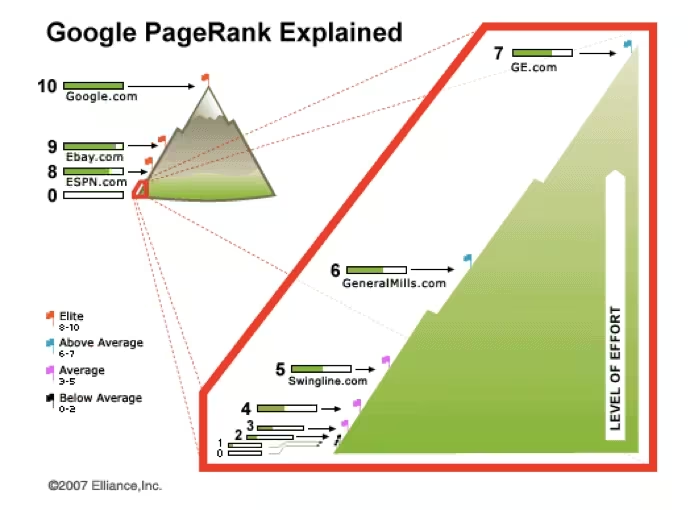
Google says “PageRank relies on the uniquely democratic nature of the web by using its vast link structure as an indicator of an individual page’s value. In essence, Google interprets a link from page A to page B as a vote, by page A, for page B. Webpages with a higher PageRank are more likely to appear at the top of Google search results.”
You can check your own Google PageRank at smallseotools.com.
Now I’m going to burst your bubble a little. The last Google PageRank update was on 6 December 2013 so they haven’t been showing us what our websites rank since then. Matt Cutts from Google’s Webspam team posted a video back in 2013 to explain what they were doing with updates to PageRank…
If PageRank no longer is being updated, how can you understand which sites have a higher authority than yours? Thankfully Moz.com have developed a tool called Domain Authority Checker which gives a lot of detail for free about your own site and other people’s sites in comparison to your own.
They call this ‘Domain Authority’ and it’s the term we’re all starting to use a lot more than worrying about Google PageRank. It uses similar ranking metrics to Google but provides a result from 0 to 100, which roughly corresponds to Google’s 0 to 10. i.e. a Domain Authority of 34 is roughly a 3 in PageRank. Using these metrics will help you to understand more about how Google ranks your website.

