Marketing for Architects in the Age of Insularity
The 2026 Edelman Trust Barometer surveyed 33,938 people across 28 countries. Its headline is blunt: trust has retreated inward, toward the small, the local and the familiar. For architecture and

When we’re auditing a website for search engine optimisation (SEO), one of the common errors we find is the use of underscores in URLs and image filenames rather than hyphens. It seems like a tiny point to deal with but for SEO it can be really important to get this right as it helps establish the keywords Google will index.
More importantly, we are often dealing with small websites where every bit of organic traffic is really key to growing sales. We know that Google Images can be a really great source of organic traffic for the furniture industry and is often overlooked by the larger websites who manage their imagery in a different way, i.e. they have a database that generates image names for them so cannot optimise each filename. This is where we can mop up some traffic.

I often get asked whether I’d recommend dashes [hyphens] or underscores for words in URLs. For URLs in Google, I would recommend using dashes [hyphens]. Why? To find out, let’s take a trip in the Google Time Machine. Set the dial for 1999, the year Matt first discovered Google. Matt was using, I dunno, maybe HotBot at that point? The curtain rises:Matt: Hmm, this search for [FTP_BINARY] didn’t turn out the way I wanted. I got a couple scuzzy looking urls, and the other documents just have the words “FTP” and “BINARY” but the term “FTP_BINARY” doesn’t actually appear. (Note: Matt was a bit of a nerd, as you can tell.)
Some Random Person That I Don’t Remember: Have you tried Google?
Matt: What’s that?
SROTIDR: It’s a search engine written by nerds for nerds! They index numbers! Sometimes they even index punctuation, like “C++”. Try your underscore search there.
Matt: Okay, here goes. Whoa! They actually return pages with the literal string “FTP_BINARY”! That’s wicked cool! (Did I mention Matt was a nerd? Big-time nerd.)
SROTIDR: Yeah. The wild thing is that they wrote a paper about how they crawl the web and rank pages.
Matt: Well, now that’s just silly. I wonder why they didn’t keep it a secret? I bet those papers will make great reading for my information retrieval class.
Taken from his blog post on the same topic, Matt Cutts explains that there is a good reason when to use underscores and when to use hyphens.
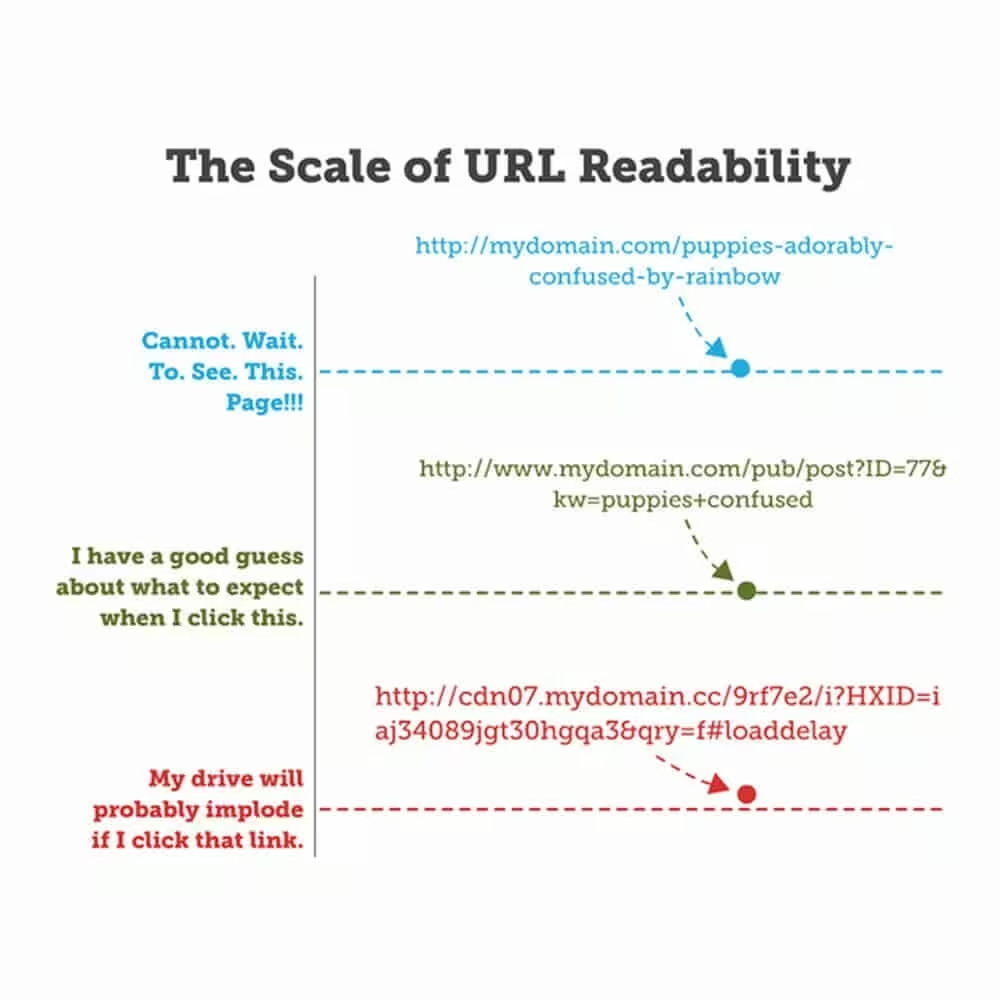
This is a key point to note because getting it right means your keywords are used from URLs and getting it wrong means that ranking factor is not working for you. Of course, this is one of over 200 ranking factors Google use to decide where to place you so don’t panic if you’ve got it wrong but when creating new pages, it’s best to consider this.
Hyphens. End of story.
Matt Cutts explains more in this video…
Split words using hyphens so that each word is seen separately. For images, using Photoshop’s Save for Web will automatically add hyphens for you so you don’t have to do anything, but remember to use nice descriptive words.

